The Experience of a Dialogue
Young people read far less than previous generations, which affects both their understanding and expression. However, if we really strive for an authentic dialogue, another issue becomes clearer. They miss the experience of being listened to, a true informational and emotional exchange.

“How can you overcome the impostor syndrome? How do you know when you are knowledgeable enough to even be allowed to write on a topic without being superficial?” This question made me shiver. It was asked by a twelfth-grade student (as I’ve spent last week speaking to many school students of my former high school). I shivered because I’ve seen myself in his question, when I was just a bit older than he is. I was studying physics, then mathematics and while I felt I was in contact with top-shelf information and researchers, I wasn’t aware of how much of that I’m actually learning. Exam grades were one thing, but what do I really know? When can I call myself a mathematician? In my final postgraduate year, I told a colleague with excitement that I’ve found what I want to do, that “my specialty is algebra”, to which she replied, “You know, Adrian, specialty is quite a strong word.”
Therefore, the imposter syndrome sent me a couple of years back, but at the same time, it resonated with what I feel now. “I don’t think you ever manage to overcome it”, I replied, “but it’s more about intellectual honesty and openness of your mind for any kind of dialogue than the feeling that you know”. You can bet you’re starting off with insufficient information but try to catch up as much as possible. When you think you have something to say and support or argue for, do it, but keep an open mind. There will always be people who know much more than you do and, if they have good intentions, they will let you know and thus a dialogue starts. I’ve said it repeatedly: I write and talk to start dialogues. Nothing excites me more, at the end of a text I publish or a talk I give, than comments, questions, or opinions, especially those who disagree with me.
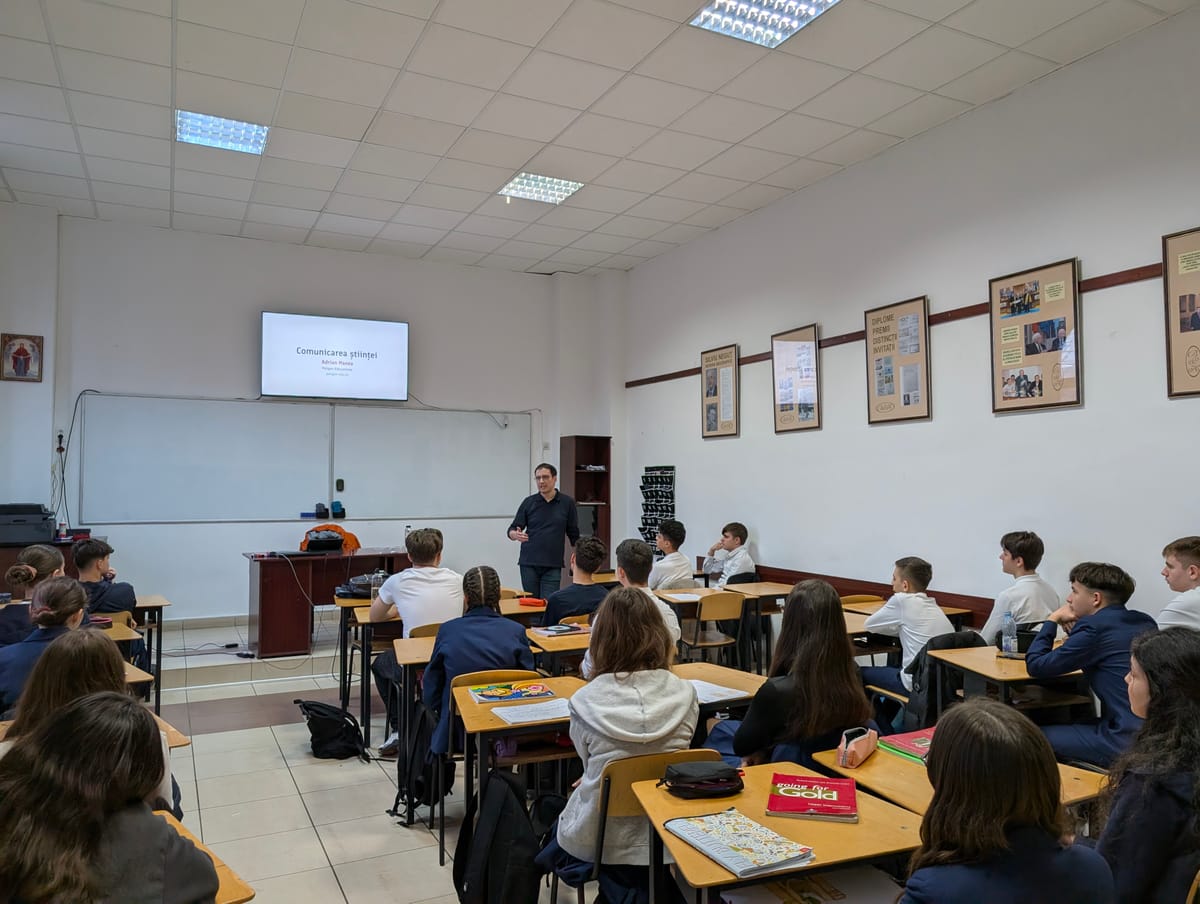
I spoke to seventeen classes in three days, in all specialties and years of study. I don’t know if this gives me a good big picture, but I noticed that all students are curious, have passions, and want to communicate. At the same time, many of them have the intellectual and spiritual selfishness that I share sometimes: if a topic is not attractive personally, then I can’t be forced into liking it. If you get my curiosity, you will have my attention. Nevertheless, I have started dialogues with them, and I think that’s the most important outcome. I was prepared with various topics and rarely have I failed to connect with at least a couple of looks to spark questions or comments.
Music, nature, travel, technology, and sports were the main topics of interest for the students, but I did encounter a couple of exceptions that I want to highlight.
A ninth grader told me that she reads the magazine Vogue almost embarrassed thinking that I will scoff at her superficiality. But her embarrassment quickly vanished when I told her that I’m genuinely curious about this magazine, that I’ve been intending to read for a long time, without getting to it yet. So, I asked her to sell it to me, help me take the final step to get to read it. Her answer was fascinating: many of us think that Vogue is mainly a fashion magazine, but she was very interested in keeping updated with this world of aesthetics in parallel with socio-political news and historical events. She even reads the magazine archive to see trends in fashion and compare them with global historical events which brings a fresh new look at both.
Another student, a tenth grader, told me he reads a lot of history and has a passion for the history of communism. He participated in the workshop I organized and had a title ready for his debut article. He even had a pen name to add to his real name.
On the topic of the workshop that followed the seventeen presentations during the week, my goal was to get into details and start working on a first draft for an article or at least find a topic, a title, and a nutgraph. The students who came were delightfully diverse. I was equally happy to find that most of them had prepared topics, even if I had some suggestions.
But more than the topics themselves, they had clear objectives. A student who had published poetry and short stories wanted to learn to write simpler and with a more realistic tone. Another student was surprised and encouraged by my presentation, thinking that people her age are “not allowed” to publish. Another one, who is passionate about music and communication, had been watching many clips and reels on hooks that draw attention, tips and tricks to make your audience curious, since this is a common objective for music and communication alike. But although he had composed some music, he felt he hadn’t practiced enough in verbal communication. So, he came and in more than an hour, he wrote, rewrote, and erased over two pages filled with attempts to write. In the end, he left without a single paragraph he liked, but excited by the lesson: it’s a lot more complicated to write simply, and at the same time, it’s very difficult to put into words what you feel and find obvious. When you try to explain (to say nothing about attention grabbing or convincing), words are very hard to pick and tame.
One of the recurring questions I got was “How can I reach a broad audience?” This was more prominent in the classes who study natural science, and I insisted that medicine and pharmacy are topics that we all think we know, just like football and politics. This makes the delivery of correct information all the more important coming from (future) specialists, since the link between the experts and the public is dangerously severed, with equally disastrous consequences. On the topic of public and individual health, I think that it is very important to reach a wide audience, but marketing and publishing are two separate domains of expertise. Even so and even if it is not easy, I believe that good communication on a topic that should be of public interest can promote and sustain itself, at least until you get in contact with someone who can carry your words and articles further than you can do it yourself.
But it’s not always about numbers (the students were very surprised to find that the writers are not told how many clicks and readers their articles got). Since patience is not a core attribute of many youngsters of their generation, the pursuit of thousands of followers and readers can seem discouragingly difficult. Add to this the impostor syndrome and you get reluctant students and young people who could otherwise have things to share with us, adults, who think we know everything about them.
In a sense, this was my main message, and I like to believe that it reached the majority. I acknowledge that the informational deluge, the overcrowded feed, and communication channels which can feature literally anyone could seem intimidating. But it is equally true that we all have preferences and, at least privately, we make judgments and have strong opinions. In this landscape where everyone fights for our diminishing attention span and where threats like doomscrolling and brain rot are at every corner of the internet, I think one must take a first step of spiritual and intellectual sanity.
The joke “I’ve seen it on the internet, so it must be true” tends to become a creed and not many of us understand the advantages of reading verified content that’s published by real individuals, institutions, and organizations who have a respect for the truth. But not everything must be about news, political, or socio-cultural comments. There’s enough screen real estate for passions, curiosity, and preferences that are enthusiastically articulated instead of tiktoks that feature increasingly mindless “challenges”.
Youngsters have momentum. It is natural, driven by curiosity, desire for socializing, for making a name for themselves, to be seen and heard. Before they even reach journalistic venues, there are various classes and extra-curricular activities they can engage in. Admittedly, they are hard to fit into the usually packed daily schedule that many of them have. However, I think that free talks, where students are listened to and encouraged to communicate, when the information and initiative should circulate with priority from the desk to the rest are starting points towards an open dialogue and increasing mutual trust.
I don’t know if these are solutions for young people’s lack of interest in reading and the disastrous results they have in national and international tests. But I don’t even want to think about that. It’s not in my nature to “think big”, that’s why I’m more interested in individual interactions. Therefore, I aim to do is encourage first person speeches, which should give them confidence they are heard, and for us adults, perhaps diminish the surprise that polls and statistics bring after exams or other important events in public education and communication. Allow me to close with a cliché, but one that I firmly believe in: we are missing true communication, good quality talks, speeches, and arguments where listening takes attention and patience, and speaking or writing relies on honesty and openness, thus making an authentic dialogue. Restore that and much of the rest will follow.
This was my last text of 2025. Thank you for reading The Gradient! The articles here will always be free. If you've read something useful or enjoy what we publish, please consider a small contribution by sharing on social media, starting a paid subscription, or a tip.