Lives Well Inked: Researchers and Fountain Pens
Fountain pens have a special place in the history of thought and culture for almost two centuries. We may not know how much ink has flowed for the world's fundamental equations, but there are some candid stories of mathematicians and their fountain pens.

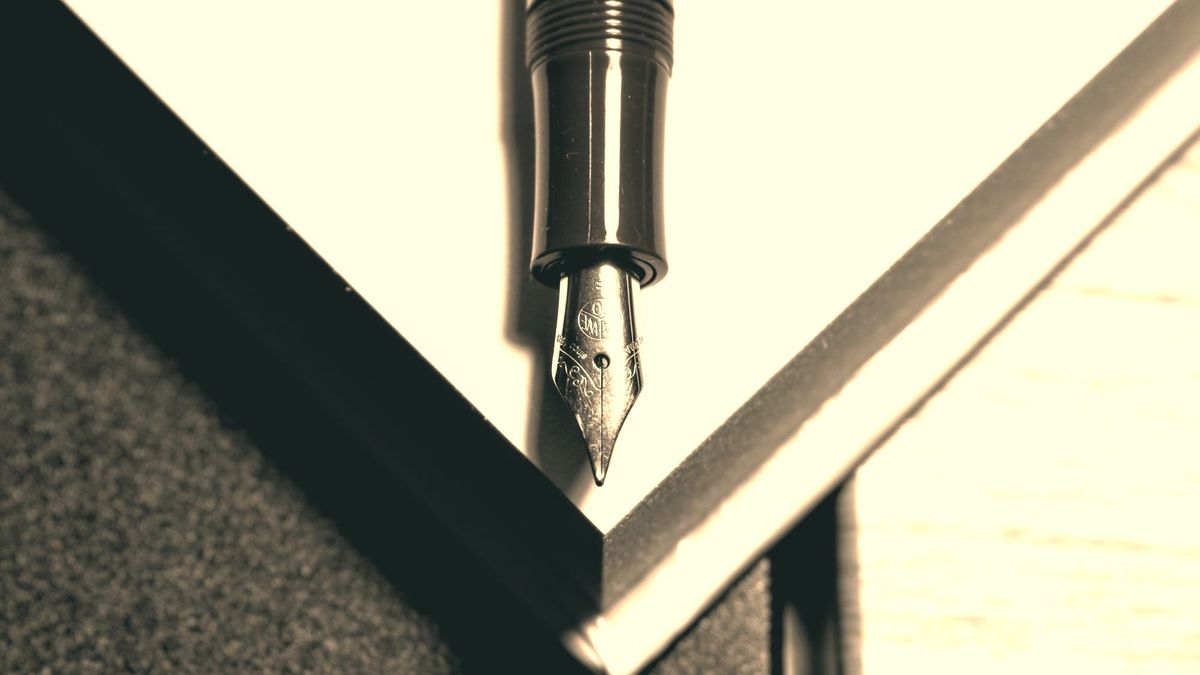
“A mathematician is a device for turning coffee into theorems”, said the Hungarian researcher Alfréd Rényi.
Many researchers say that mathematics takes shape on paper, with a pencil or a pen that faithfully follows the flow of thoughts, but also allows for correction, erasure, and retries. And in fact, this is not limited to scientific or mathematical research. Computers have never completely replaced handwriting for many novelists or poets.
While it's not the tool that produces the result, you probably know writing habits, what pens, typewriter, or software your favorite writer uses. It's the same with painters, where one hardly resists buying the very paper that Salvador Dalí used or watercolors that are named by Albrecht Dürer.
It could seem that mathematicians rarely develop passions for notebooks, pens, pencils, or ink ― or at least they rarely express such interests, compared with writers. There are fascinating examples of hoarding a type of chalk that many professors adore, but they are rather the exception than the norm. Mathematicians usually work with what comes to hand and one can bet that they will find a mug with pencils and Bic Cristal ballpoint pens in almost any office.
Pencils, Fountain Pens, Ballpoints: A Brief History
The graphite pencil was the first modern writing tool, invented in 1795, by the Frenchman Nicholas-Jean Conte. The main technical issue had been to have a graphite lead encased in a block of wood. The mixture of graphite powder with hardening agents was known and used since the 1600s, but making that into a writing instrument was not immediate.
For many years, the pencil was mainly a tool for artists or craftsmen like carpenters. The very etymology of the word, pencil, comes from the Latin penicillus, which means "small tail", related to a fine brush. The French original word, crayon, is related to craie, which means chalk, a reference to a common origin of powder bound together into a writing and drawing medium.
Feathers, dip pens, or bamboo sticks were the popular writing instruments until the invention of the fountain pen, by the Romanian Petrache Poenaru, in 1827. Several decades later, the device had spread especially in Europe, through companies like Pelikan (founded in 1838), Waterman (1884), Parker (1888), Kaweco (1889), Conway Stewart (1905), or Montblanc (1906).
However, the Hungarian journalist László Biró grew annoyed by the time required to refill fountain pens, the long ink drying times and the occasional leaks. So he worked with his brother, a chemist on developing a more viscous ink that dried quicker, a reservoir to last longer, and a special kind of nib, for which they added a small rolling ball that helped the ink flow and reduced friction on paper.
Their invention was presented in 1931 in Budapest, and it became such a huge success, so much so that in some countries ballpoints are still called “biros”.
Writing Persists. What About the Pens?
But Biró had his reasons for rejecting fountain pens. As a journalist, he usually traveled and needed to take quick notes, sometimes while standing or in unusual positions or places. Carrying an ink bottle was also not an option, nor was stopping for refills, or blotting excess ink. A spill on handwritten notes or interviews could have spelled disaster.
The historical challenge of tracking mathematicians using fountain pens is (perhaps not surprisingly) hard. Except for the rare cases when a researcher was photographed with their pen in hand or the even rarer occasions when they wrote in a diary or a letter about such preferences, the connections historians made are mostly based on archival analysis.
Before becoming widespread and export goods, fountain pens were sold to local markets. Most schools used them, and many still do, under the assumption that they improve calligraphy and hand grip. Thus, there were many pens throughout the years that emphasized finger comfort. One of the most famous is the triangular grip of Lamy fountain pens, especially in their ABC model, designed for school children.
Nowadays, the popularity of fountain pens is decreasing, along with handwriting in general. But several decades ago, you could bet that all school children were educated to use them. Despite obvious advantages of ballpoints, the momentum of a century passed from Poenaru's invention to Biró's made fountain pens almost irreplaceable, at least in some schools.
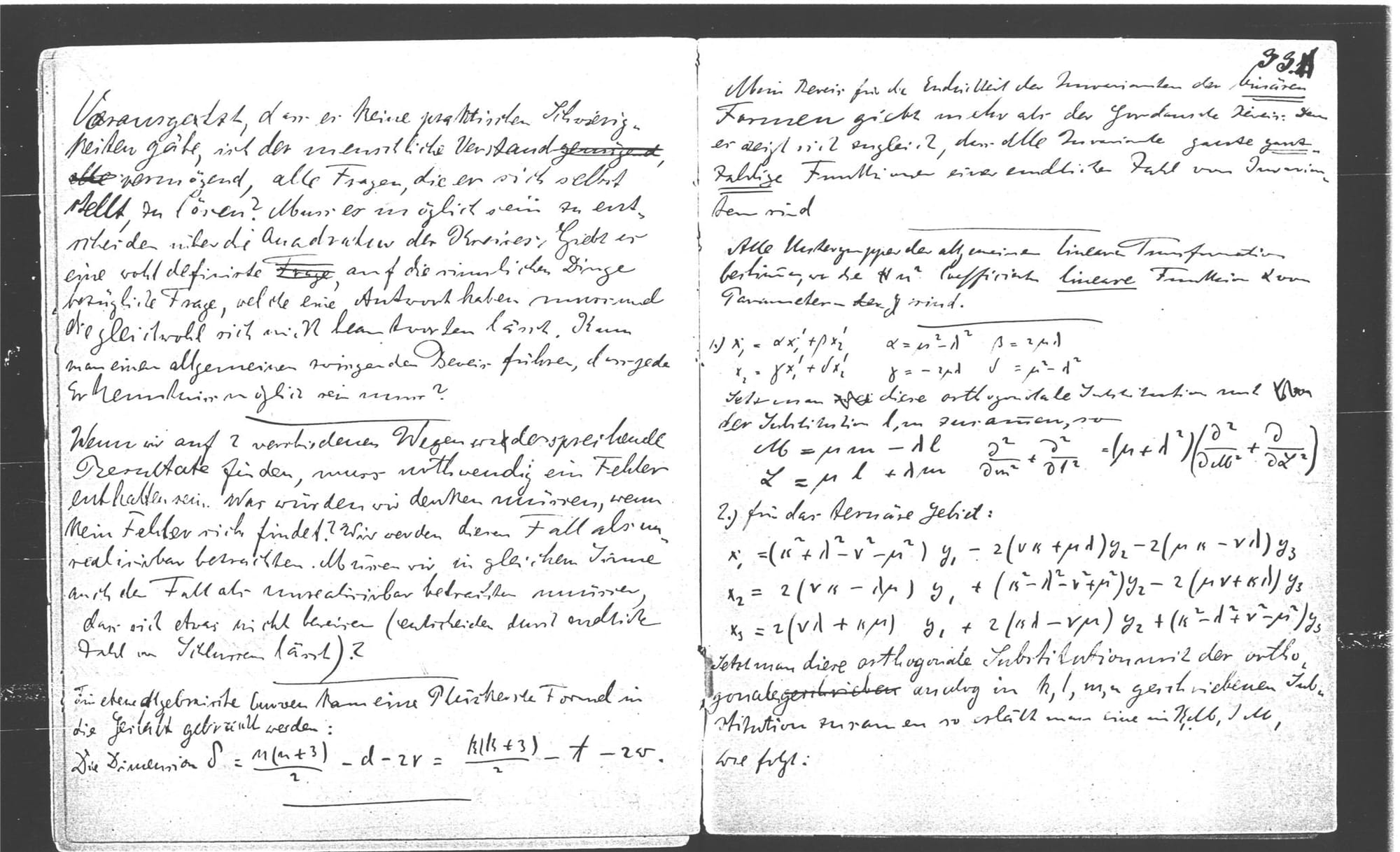
Graphologists, archivists, and historians found further proof of fountain pen uses in expert analysis of ink traces on paper. Many inks had specific formulas of precise chemical components, such as iron gall (which is still used in archival ink), and there was not much variation in color.
Similarly, nib grinds were not very diverse, but each brand had its technique. That's how experts could deduce, with reasonable probability, the type of pen and ink used in some manuscripts.
The inventory of the estate of a defunct mathematician could also be used as proof, since one could say that if a fountain pen was found on one mathematician's desk or among their possessions and it was not sealed or brand new, then they could have used them.
Few Verifiable Examples
Such introduction and precautions out of the way, here is a clear example: the late mathematician Nick Higham. In a post on his personal blog, he wrote about his preference for inks, but not specific pen brands. Previously, he had written about pencils, but then he steered towards fountain pens.
His preferred inks were made by Noodlers, an American brand known for high intensity pigments and quick drying times. Higham used various colors of ink for specific tasks. He graded paper with red, or orange ink made by Waterman, annotated research materials or books with Pilot Iroshizuku inks, and used Diamine for his all-purpose writing (Asa Blue, Oxford Blue, and Red Dragon).
Going further, the scarcity of available information leads me astray so the examples that follow are well documented but not strictly of mathematicians.
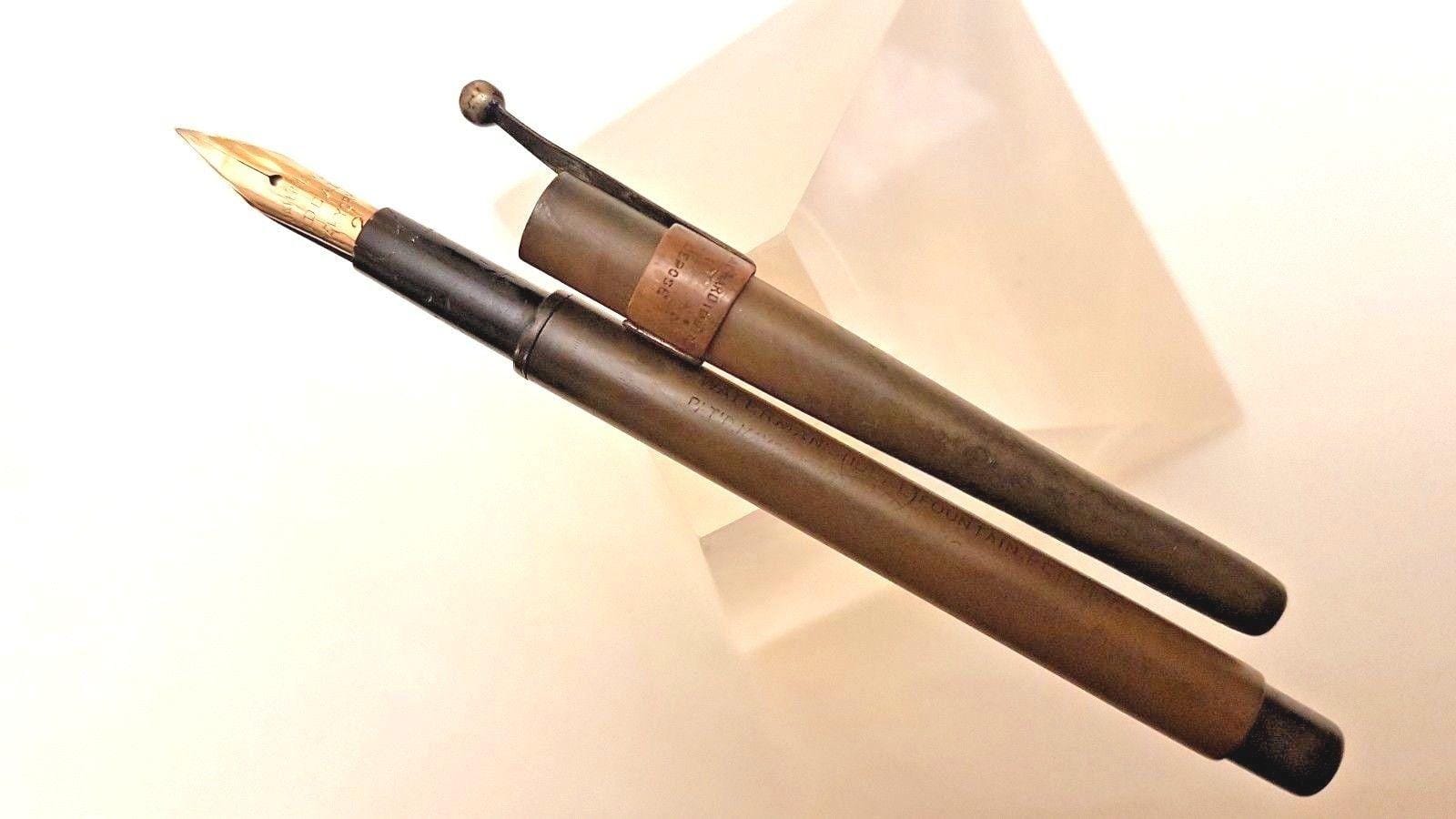
Albert Einstein's fountain pens were made mostly by Waterman, Pelikan (model 100 most likely), and Montblanc. The Fountain Pen Network online community discusses such details. One of his pens was the Waterman Ideal 22, which can be seen in the Boerhaave Museum in Leiden. Einstein received it as a gift in 1921 from the physicist Paul Ehrenfest and we know for certain that he used it when drafting the general relativity theory.
Also coming from physics, but from the present, is Neil deGrasse Tyson. In an interview from 2017, Tyson displays his collection, most instruments being made by Montblanc, given his preference for larger pens, like the model 149.
The same pen was among the favorites of Edsger W. Dijkstra, one of the most influential theoretical computer scientists. Renowned for his impeccable calligraphy, and for the lack of references in his articles, Dijkstra used many fountain pens, which he discusses in this interview. Being rather theoretically minded, Dijkstra never wrote his articles on a computer. In the obituary that Krzysztof R. Apt published in 2002, it is written that Dijkstra used typewriters and fountain pens, usually by Montblanc.
Speculations
The rest of the examples I came upon are not as solidly supported by evidence as the rest and rely mostly on associations and speculations. For example, the British mathematician and philosopher Bertrand Russell (1872-1970) could have used fountain pens made by Conway Stewart or Onoto, both founded in 1905. We know for sure that Sir Winston Churchill was a client, for example, so there is a chance that Russell could also have owned such pens.
In Conway Stewart's catalog of clients, one could possibly find Alan Turing as well. A preprint from 2012 shows that Turing had a fountain pen called “Research”, which was gifted in 1932 then sadly lost. The nibmeister Richard Binder writes that the generically called "Research" pen is very likely to be a model patented by Alexander Munro in 1916.
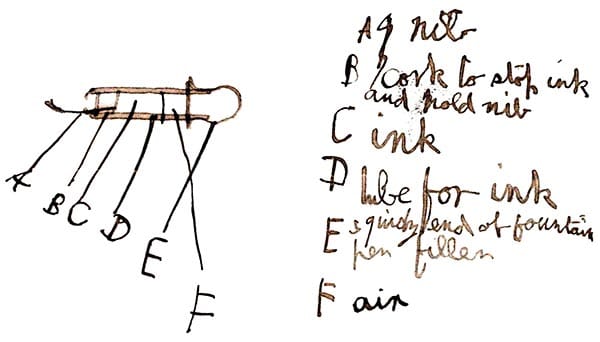
Turing was passionate about fountain pens and inventions since childhood. During his school years, since he was 10-14 years old, he designed his own fountain pen which had a rubber end like a medicine dropper, and the nib seal was made of cork.
Recently, Conway Stewart dedicated two fountain pens to Alan Turing, which can be bought from the National Computing Museum in Bletchley Park ― the former HQ of the cryptography group during World War II. They released a limited edition, with 251 pieces, and another one that celebrates Turing's collaboration with Gordon Welchman. Both have intricate details that represent Turing's work on the Enigma machine.
Another direct example, but quite imprecise, is that of Kurt Gödel's letters to his mother and family. For example, in a note dated 1949 he writes:
P.S. My poor handwriting is explained due to the loss of my fountain pen and the new one is not worth anything since I wanted to be frugal and bought myself one for $1.50. I lose my fountain pens from time to time and then am annoyed if they were expensive.
We don't know the model that the Austrian used, but correlating his life with the German market would suggest either the Pelikan 100 model, sold between 1929 and 1944, or the newer model (100N), available from 1937 to 1954.
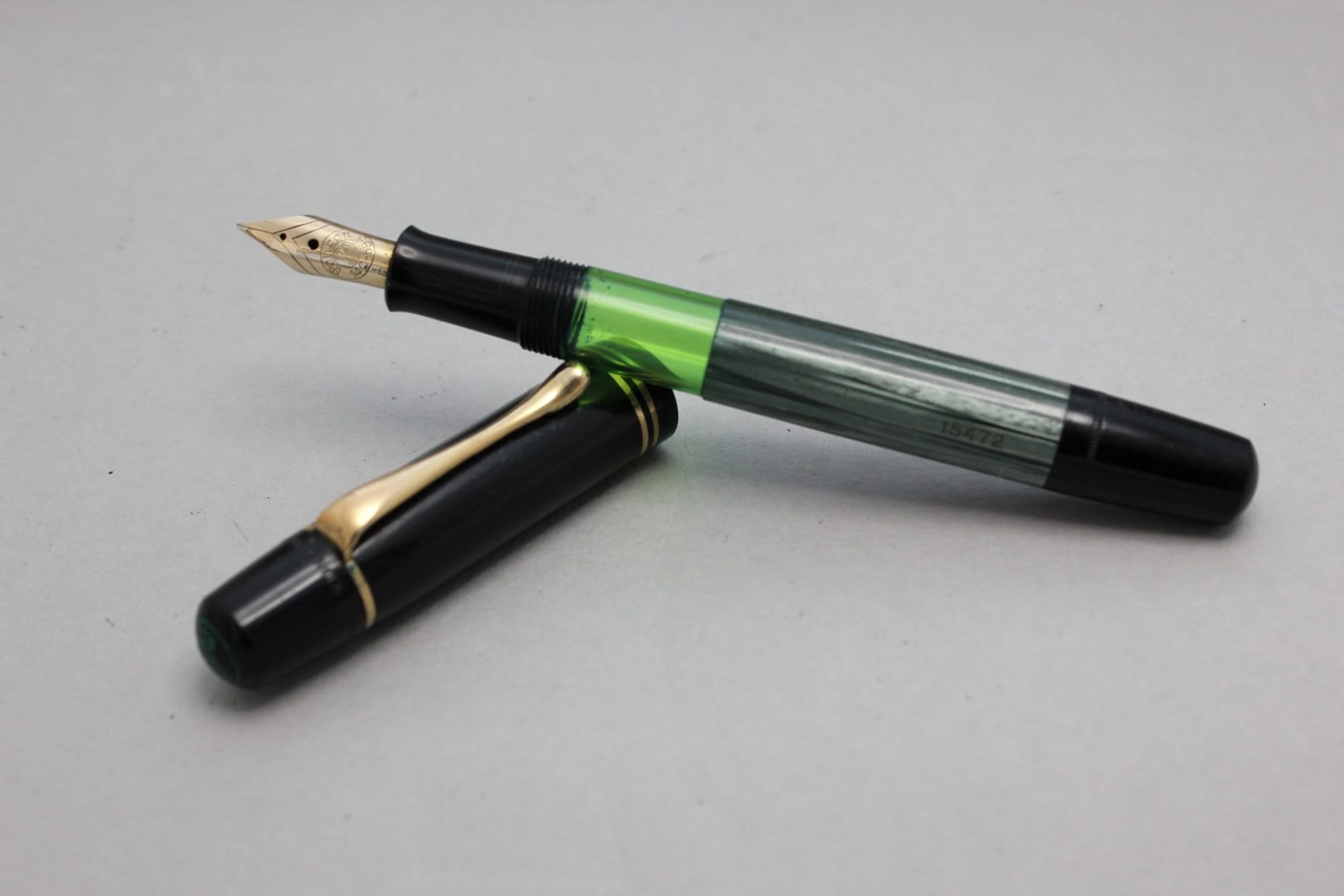
In other letters, Gödel thanks his mother for sending him books, accessories, and fountain pens, but in the 1940s, the packages were often checked by the Nazis, and not all reached their destination.
Then in 1954, Gödel writes to his mother, from the USA, glad that he could send a new fountain pen: “It is a new kind of fountain pen that sucks up the ink via a nozzle.” he writes. A historical analysis suggests that it could have been the Sheaffer Snorkel pen, an American brand which produced this model from 1952 to 1959. It features a metal rod like a straw that is lowered through the nib to suck ink in the barrel.
We fountain pen enthusiasts appreciate such details and gimmicks. We love variety in terms of nibs, filling mechanisms, ink colors, or paper properties. Beyond such material details, we appreciate the experience of writing with a fountain pen. The slowness that it imposes, the tactile feeling of friction between the nib and paper, the traces of ink drying under our eyes, the line variation, and not least emptying and refilling the reservoir.
Beyond being a writing instrument, a fountain pen is one of the most personal items that could own. Handwriting will not become extinct if there are still people pouring their minds and souls into ink, directly linking their minds and souls to the words or symbols committed to paper.
We may not know how many researchers shared this passion, how many used fountain pens simply for the lack of a better alternative, or treated them like simple tools. There's no doubt that their theorems would have shined the same light even if they scratched them with their fingernails on the walls, they wrote them in pencil, or they dictated them. But I like to believe that for almost 200 years, fountain pens have been connecting minds and souls looking for a deliberate slowness, to savor the moment of creation and paying attention to the marks they leave on paper, on history.
Thank you for reading The Gradient! I do my best to keep the articles here free to read. If you've read something useful or enjoyable please consider sharing this post on social media and get in touch. Do you use fountain pens?