Please Make Something Flawed
This is how experience works, it settles around the self like a sediment, and the self, as the possibilities open to it increase in number, becomes more and more difficult to nail down: the wisest person knows that ‘I’ is nothing in itself. — Karl Ove Knausgård, Autumn


Perfection is boring. When you know everything there is to know about everything that can be known, there’s nothing else to discuss, nothing to debate, nothing to learn and no one to learn from. Dialogue makes no sense, as information transfer is one-way. Perfection embodied knows everything, so you, as its “client”, are only left with listening and learning, in you own limited way, while being aware that you’ll only grasp approximations which keep you at a distance.
If the only goal of any effort is the end result, then the binary world we would inhabit would end up making the tools that ensure production; regular, constant, precise, up to that boring perfection to be dreaded. Attempts would become vain if the “success” is guaranteed by means of a machinery.
When I was in high school, I proudly held that the classical poets don’t impress me. Instead, I grew more fond of modernists like Tudor Arghezi and Nichita Stănescu. I can’t say I understood much of their work, especially some philosophy-infused poems, but I was convinced that there are meanings which I will eventually discover.
One of their poems came suddenly to my mind while I was planning this text. It’s called “A Lecture on the Cube”, written by Nichita Stănescu, and in this translation goes something like this:
You take a piece of stone,
chisel it with blood,
grind it with Homer’s eye,
burnish it with beams until the cube comes out perfect.
Next you endlessly kiss the cube
with your mouth, with others’ mouths,
and, most important, with Infanta’s mouth.
Then you take a hammer
and suddenly knock a corner off.
All, indeed absolutely all will say
what a perfect cube this would have been
if not for the broken corner
I think this ars poetica is a model, an urge to which I subscribe after more than half a century. The Lecture on the Cube appeared, almost inevitably, in Stănescu’s volume The Imperfect Works from 1979.
Strive to give your best. It is only natural to aim for perfection, but it never is the end result. Use your best tools, but not to make The Cube. Instead, focus on your skew monument, which was your choice to make in spite, or perhaps precisely for the public criticism.
I think the only effort worth making for the sake of the end result is education. At the same time, clearly education cannot have an end result as it overlaps significantly with experience. Hence, you give all you’ve got for the process.
In fact, my praise for imperfection, or the lecture on the cube is, first and foremost, a hymn for the process, a lecture on “how”. Not on having made, but on how to be making.
Nowadays, work made or done is several clicks away. Artificial intelligence spares you the chore of the process and delivers the end result directly.
Surely we all have tasks we are better or worse at, as well as some we don’t care about, or don’t have enough time for. Still, they must be finished. The fact that all help we used to get from friends or the internet is now compressed in AI assistants is not a bad thing in itself. Ultimately, there are many tasks for which the computer, even before the AI age, was designed to overcome our capacities by several orders of magnitude. It’s alright for things to be this way, and it is the very reason why we have and use tools: to help us overcome our inabilities, to augment our capacities. But the passage from using a tool to outsourcing to a substitute should be treated seriously, although on a case by case scenario.
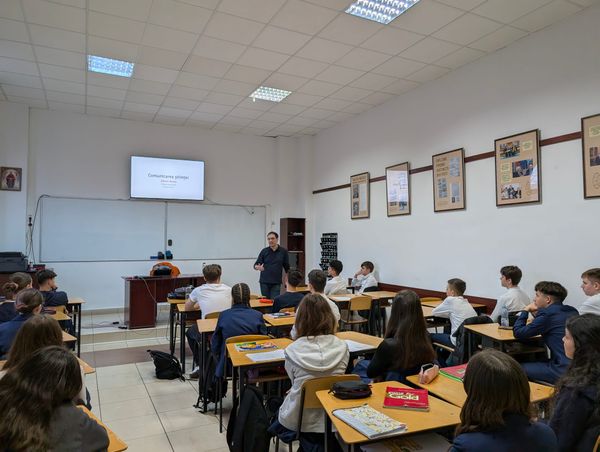
Perhaps I will be frowned upon, but I do see myself in my students’ shoes when they told me they’ve prompted the AI to fully document and write some of their essays for homework they didn’t care about. There’s no excuse, even if I’ve just said I understand their decision, but when a teacher leaves as homework an essay on a topic that they could have discussed, explained, and debated with the students, perhaps the fault is to be shared. A live and open discussion could never be replaced by a simple “essay”, and even less one that high school students are not trained for in terms of proper documentation and survey.
But my initial intention was to write about experience, including education, by trusting and surrendering oneself to the process, not to the result.
It was said previously by a great many more influential and wise people than myself (under the guise of “the journey is much more important than the destination”), but I think we were never in a more suitable situation, from a technological and technical point of view than right now.
In an essay published by The New Yorker, Joshua Rothman wrote about AI assistants used for writing. In closing his piece, he quotes the two members of Daft Punk:
In an autotuned or A.I.-synthesized world, perfection and imperfection carry new meanings: the human faults that technology irons out become perfect in their own way, and the smooth surfaces created through technology risk feeling blank and featureless. “Our relationship with technology is very ambivalent in the fact that it’s a very strong love-hate relationship,” Thomas Bangalter, of Daft Punk, told the art magazine Whitewall, in 2009. “There is no limit anymore with technology.” But, he went on, “any kind of human behavior has to be put against some kind of frustration.” The same technologies that expand the creative process also threaten to short-circuit it. To be an artist, Bangalter concluded, “What you have to learn is restraint—put your own limits.”
But not all is about art or artistic expression. Dan Meyer from Desmos (thanks, Măriuca!) wrote on Substack that educational tools which give you everything premade don’t do their job, precisely because everything is already processed and what you’re left with is to swallow them whole. Critical thinking, questions, interactions, friction in general is gone. Students just have to memorize, they don’t see how it was made and, finally, they end up quitting, because they don’t feel any motivation to keep learning. The educational process starts to resemble the relationship between a huge storage unit and a small container that cannot keep up with the influx. And when it does, it only has to passively store finished products.
The goal of any educational process is not to pile up information. No doubt memory does play a role, but my own experience showed me that memorization sets you up for “all or nothing” situations. You either have the required information and simply retrieve it, or you don’t. Whereas learning, not only from school or any kind of education, means abilities and experience. Instead of pieces of information that you either retrieve or not, an educational process should show you how to remake, and unmake, if needed, the required steps, so that the result becomes a mere deduction or a natural conclusion. You shouldn’t know that something is true or equal X, but instead, master how to reach such conclusions.
Furthermore, to close the circle, memorization and understanding of steps to reach a result entail logical abilities, critical thinking, as well as technical and scientific knowledge. Computers can very well perform those computations — it’s the reason why AI and specialized software excels at math and programming more than anything. They are well suited for situations when steps are clear and flow logically one from the other, and the results are mostly deterministic.
However, our human essence is defined by actions and attributes such as improvisation, imperfection, and curiosity. Music making software usually has a special effect called humanization, which errs just slightly, almost invisibly and inaudibly, in the tempo, pitch and/or duration, thus giving character to the song. In painting, photorealism was never a movement as big or as important like impressionism, cubism, or expressionism. This is because it’s a lot easier, from the point of view of the message, of the content, to have something true to a model, “faithfully realistic” than a creation that means something, where circles are just a touch elliptical, and the cubes have a broken corner.
The result is not imperfect because you’ve given up, but instead, because like Bangalter said some lines above, you decided to set a limitation, which you accept and respect precisely to make something your own. Same goes for the educational process, where efforts, with or without the desired result give you something much more valuable: the possibility for expression, for experience, and finally, for creation of your own self.
Thank you for reading The Gradient! I do my best to keep the articles here free to read. If you've read something useful or enjoyable please consider sharing this post on social media and get in touch. What did you make today?