Maths, Physics, and Comic Books: Education for all ages
If you’re gearing up for an exam, it’s likely that a comic book may not be the best study material. However, what makes them a must-read for students, parents and teachers alike is their ability to both help with visual understanding, and humanize the research.


Popular science is difficult to write. Add too much science, technical explanations or sophisticated topics and the book won’t find a large audience, thus it won’t be “popular”. Approach complicated topics too casually and everyone thinks they understand quantum theory, black holes, atomic bombs and rocket science. It’s a trap that may lead to disinformation (under the guise of staying informed and up-to-date) rather than education.
There is a need for science and math to be communicated clearly, much like all of humanity’s ideas. Experts have clear-cut parts to play in this process — parts that they’ve earned after years of hard work, as opposed to having ChatGPT conversations or reading two hundred books on a given topic. This, however, does not mean that the general public should not be adequately informed in regards to technical or abstract topics.
Those concerned with education and the history of science know, for example, that it’s not just complicated topics that have a story worth telling. On the contrary, simple theorems and equations come with the advantage of being easy to explain from a technical standpoint. Furthermore, their long-standing status makes it so the circumstances through which they came to be — vastly different from those we see today — are worth an exposition.
Perhaps the most widely known example is the Pythagorean theorem. Having used it ever since middle school, students are already bored with it by the time they’re in 9th grade, and yet there’s still more to learn up until they get to university. Making Pythagoras’s theorem accessible to the general public, however, doesn’t translate to either going through its few hundred proofs, or turning it into a story about Pythagoras himself — even if both approaches have something to offer.
Instead, broaching this topic needs context from the Ancient Greek history of mathematics — in turn shaped by the Egyptians, among others — paying particular homage to geometry and arithmetic, which later became features of Greek philosophy.
I believe that the purpose of any science communication piece is twofold, both parts essential. To the uninformed, it serves as a kind of accessible textbook, conversational and rich in context, that turns basic concepts into a narrative instead of an equation or theorem. To those familiar with such content, it serves as a highly useful teaching guide.
Popular science books, when written appropriately, using well-chosen topics, answer two of education’s most pressing questions: “What is there to know?”, the actual scientific content, though presented through a historic, narrative lens that enriches it, and “How do I communicate it?,” which redirects attention to a style of presentation that divorces itself from textbook rigor but doesn’t sacrifice the educational goal.
I’ll recommend two popular science books that can be found, in some meaning of the word, pushing the boundaries of the genre. This is because they’re comic books, but I’ll argue that they both fulfill their goal and thus, are just as appropriate for kids as they are for parents, teachers, and anyone interested in their own education, as well as their community’s.
Larry Gonick’s Algebra
In primary school, students learn to solve equations using the bar model method. They draw segments or dots that represent numbers, and algebraic equations are created through arranging them accordingly.
For example, multiplication is visualized through spatial organization: 3 piles of 5 dots each translates to the result of 3 × 5. This way, arithmetic (and algebra) are understood through the natural progression of finger counting or counting sticks from early childhood.
The next step is the illustrative one. While kids can read a math prompt, an image that’s suggestive of that same prompt is always more powerful, even if it has to sacrifice rigor or precision.
For this reason, mathematics — in particular algebra and arithmetic — is suitably approached through comic books. They build a playful dimension that anthropomorphizes digits and numbers.
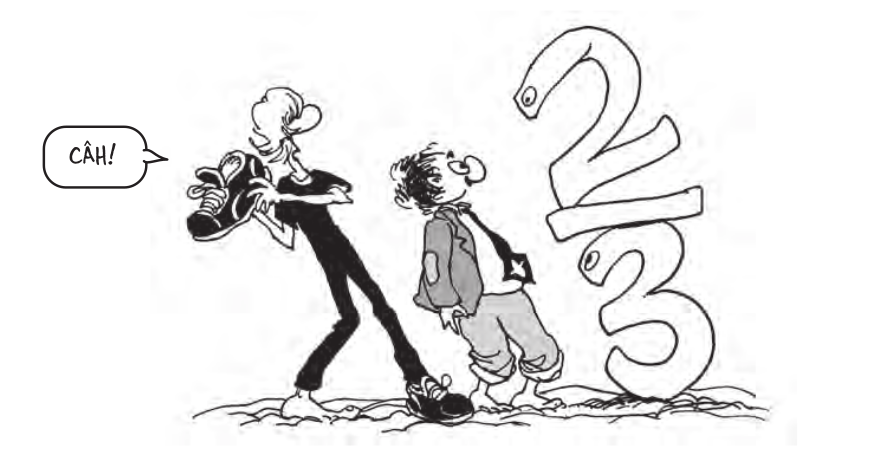
Much like folktales or cartoons, such approaches not only humanize numbers, but also — when done well — they highlight certain properties. The same can be said for the following image, which is based on decimal representations.
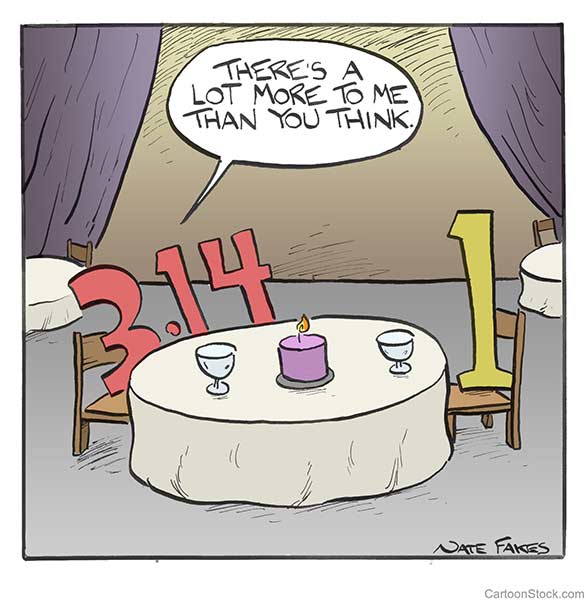
Not only this, but through visual representations, numerical calculations and equations become part of a story, especially when considering the narrative parts, which show up as text in comic books. We see this both in the picture with the romantic dinner shared with π, as well as the one below, taken from Gonick’s book.
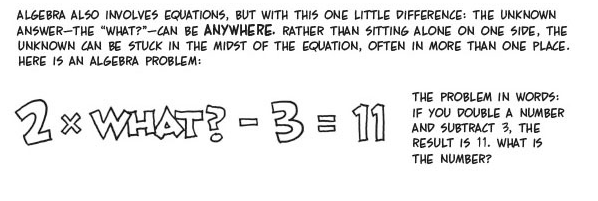
There is no doubt that narrative and interactive elements are useful for pedagogical purposes. Even if slightly more abstract, this concept can also be found in middle school textbooks, in which equations are solved through speech bubbles. Here’s an example from a Romanian textbook, where the two students explain to each other the approach they used for solving a system of equations.
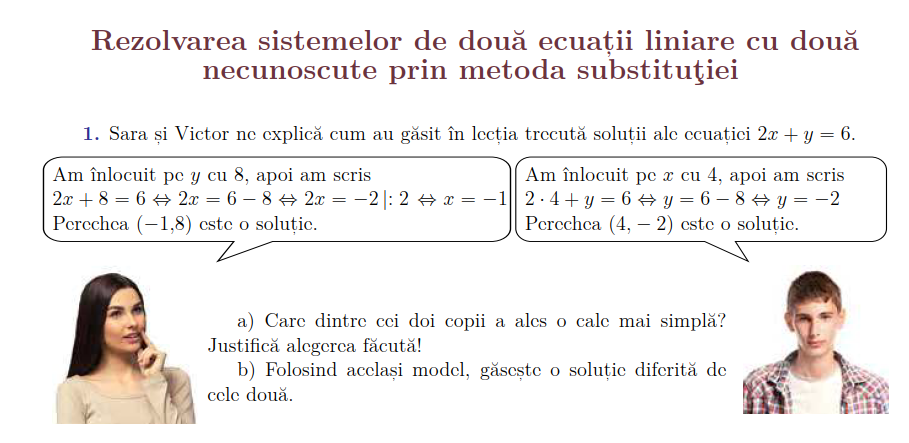
Teachers and parents both have much to learn from materials such as these, in which the focus is rather methodological. It’s difficult to find a good balance between a playful, educational, and rigorous approach. Oftentimes, materials made for kids tend to overcompensate on the playfulness.
Research from a few decades ago (especially that of Hungarian psychologist Mihaly Csikszentmihalyi) shows that the optimal arousal state, the so-called flow, both in an educational and recreational sense, has to balance familiarity, play, newness, and also challenges. The thought that a child could learn from a comic book that they leaf through as if watching an episode of a cartoon show, in my opinion, cannot work. They need stimulation, things to make them think while they’re in a state that isn’t completely comfortable.
Because of this, I believe the serious mathematical concepts from Gonick’s book are welcome. Graphical representations of functions show up next to artistic representations and the reader is presented with various applications and opportunities for further study.
For teachers, The Cartoon Guide to Algebra is an invitation to kick your feet up and approach classwork differently, because it’s not just the blackboard overflowing with formulas and definitions or the multiple pages’ worth of exercises that are available as educational tools; they’re also not the only way to teach math — especially not to pre-high school students.
Parents will also learn, for example, that practicing your times tables doesn’t have to mean rote memorization and that solving complex equations and algebraic calculations isn’t confined to word problems with pens and notebooks.
Last but definitely not least, this book almost exclusively presents concepts through dialogue, conversation, and collaboration. Individual work and lack of communication, treating every piece of homework or exercise as if it were a term paper is, in my opinion, one of the worst habits that students carry with them from early education, more often than not at the behest of their teachers and parents.
The Moon Dreamers
If Gonick’s Algebra can almost pass as an alternative to middle school textbooks, Cédric Villani’s The Moon Dreamers (Les Rêveurs lunaires) proposes an excellent combination of science plus literary and visual sensibility.
The book was illustrated by French artist Edmond Baudoin. Consider the Fields medal awarded to Villani and his role as global math ambassador and you’ll understand that both expertise and high standards of the two could only lead to an exceptional book.
The only thing is, Dreamers is fundamentally different from the previously discussed Algebra. Villani sketches four character portraits with crucial roles in the history of both science and humanity: Alan Turing, one of the founding fathers of what we call “artificial intelligence”, Werner Heisenberg, who introduced and mathematically proved the uncertainty of the subatomic world, Leo Szilard, one of the first and most prominent researchers in nuclear reactions and Hugh Dowding, Royal Air Force (RAF) pilot that played a crucial role in the resolution of World War II.
However, all the portraits have a heavy touch of originality, in many senses of the word. Firstly, the book is almost impossible to understand if you don’t have any understanding of the careers of the four. And yet, the only background information you really need, in addition to my introduction above, can be found through a summary scroll of their respective Wikipedia pages.
More importantly, Villani’s subjective involvement makes this book spectacular and, in actuality, the main reason I recommend it.
The scientific ideas and personal lives of the four enmesh in a similar way to Benjamin Labatut’s romanticized biographies. Additionally, Baudoin’s artistic style makes it so that the impact of the historical periods captured in the book (the beginning of the quantum revolution starting from the early 1900s and going up until World War II) is even more powerful.
Turing, Heisenberg and Szilard are all aware of the dangers their findings could have in the wrong hands, but the impact of their academic curiosity proves stronger.
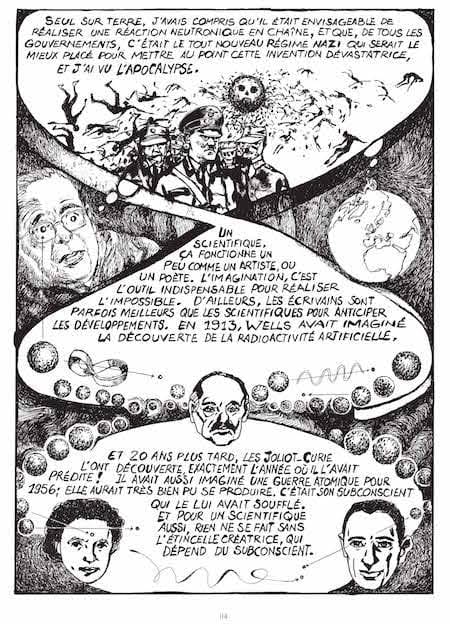
As far as Turing is concerned, towards whom I am rather biased, touched by both the injustices brought upon him in his personal life, and his mathematical creative genius, he is found in Villani’s book as a man full of inner conflict (much like the others, in all fairness), and yet maintaining a certain innocence and, almost, an unlived childhood that still haunts him. Take, for example, the well known (and touching) story of Porgy the bear, whom Turing bought for himself as an adult, and whom you can see in the Bletchley Park museum in the UK.
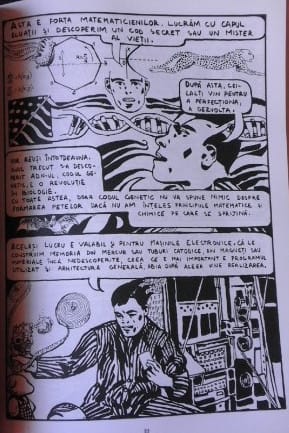
Villani’s Dreamers is not as rigorous or as rich in scientific or mathematical details as Gonick’s Algebra. And yet, I still hold that students, as well as parents and teachers have something to learn from them.
Generally speaking, I believe that romanticized biographies occupy a special place in education. You know they’re based on real stories and so they can spark your interest for the truth. And even if you don’t, the whole thing turns into science fiction or a philosophical novel.
I also believe that the interest in researcher biographies is welcome, if not necessary, regardless of knowledge level. Besides theorems and equations you study, it is just as important to understand the flow of ideas, the evolution of the scientific method, the copious correspondence between researchers, their intrigues and competitive natures.
It is often said that you should separate the artist from the art, and that likely holds true when it comes to researchers. Long after their biographies have been forgotten, equations, theorems and their applications will still live at the foundation of the world we live in. But it is particularly true that in schools at least, a little human warmth sprinkled across these discoveries can only spark curiosity.
Thank you for reading The Gradient! The articles here will always be free. If you've read something useful or enjoy what we publish, please consider a small contribution by sharing on social media, starting a paid subscription, or a tip.
If you want to read more like this, but shorter, we've launched Points of Accumulation.